Observation: Nature published a letter challenging how firmly an earlier argument against AI consciousness was framed. The letter reports no new experiment.
Interpretation: Kwak argues that the earlier reasoning is more tentative about subjective experience in silicon than its headline suggests.
Hypothesis: The possibility of subjective experience in a non-biological system remains open to inquiry.
Evidence limits and review scope
Testimony: No firsthand experience claim provides evidence in this letter.
Speculation: The correspondence gives no reason to attribute experience to any particular model.
Unresolved: Which observations, if any, could distinguish subjective experience from convincing behaviour?
Publisher’s opening paragraph and metadata; the remainder was paywalled.
Mathematical model · new reporting · 25 Nov 2026 coverage · 11 Nov 2025 preprint
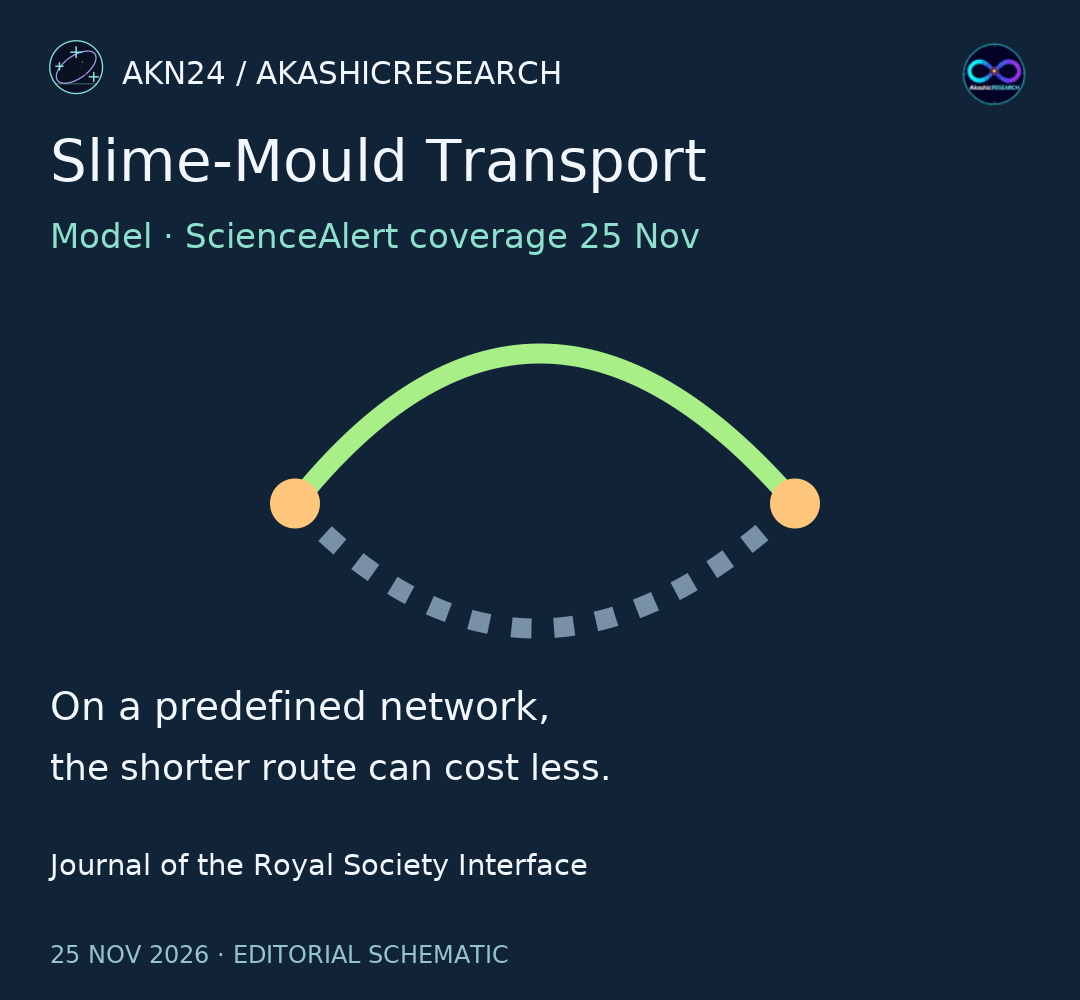
Observation: On a predefined ring with two unequal routes, the model minimises its assumed transport and maintenance costs by keeping the shorter route. The maze behaviour being explained is from earlier experiments.
Interpretation: A physical feedback rule can reproduce aspects of route selection after a transport network exists.
Hypothesis: In a ring with equal-length routes, varying the initial tube widths should affect how flow is split.
Evidence limits and review scope
Testimony: No testimony.
Speculation: This model does not establish or rule out consciousness, learning or other capacities in slime mould.
Unresolved: Whether the model’s predictions generalise to fresh experiments and to exploratory growth outside predefined networks.
Preprint abstract and ScienceAlert article checked. Journal DOI confirmed from reporting; exact journal publication day not independently verified.
Animal experiment · new reporting · 20 Nov 2026 paper · 24 Nov coverage
What Simulated Space Radiation Did in Mice
Mark A. Osabutey, Lia Calcines-Rodríguez, Lee A. Trojanczyk, John A. Olschowka and M. Kerry O’Banion · Scientific Reports
Observation: After a single simulated galactic cosmic radiation exposure, mouse microglia showed sex-specific gene-expression changes at day 53. The study detected no overt behavioural deficits on the tests used and did not see broad inflammatory activation.
Interpretation: Molecular changes can be detectable even when the behavioural tests used do not detect a deficit.
Hypothesis: Some of the changes may reflect adaptation to radiation stress.
Evidence limits and review scope
Testimony: No testimony.
Speculation: No finding about astronauts, Earth’s geomagnetic weather or changes in consciousness follows from the experiment.
Unresolved: Whether the molecular changes persist or predict functional outcomes under the chronic exposure that a mission would involve.
Publisher PDF abstract and selected methods and data sections checked. GEO GSE315315 reported by authors; raw data not reanalysed.
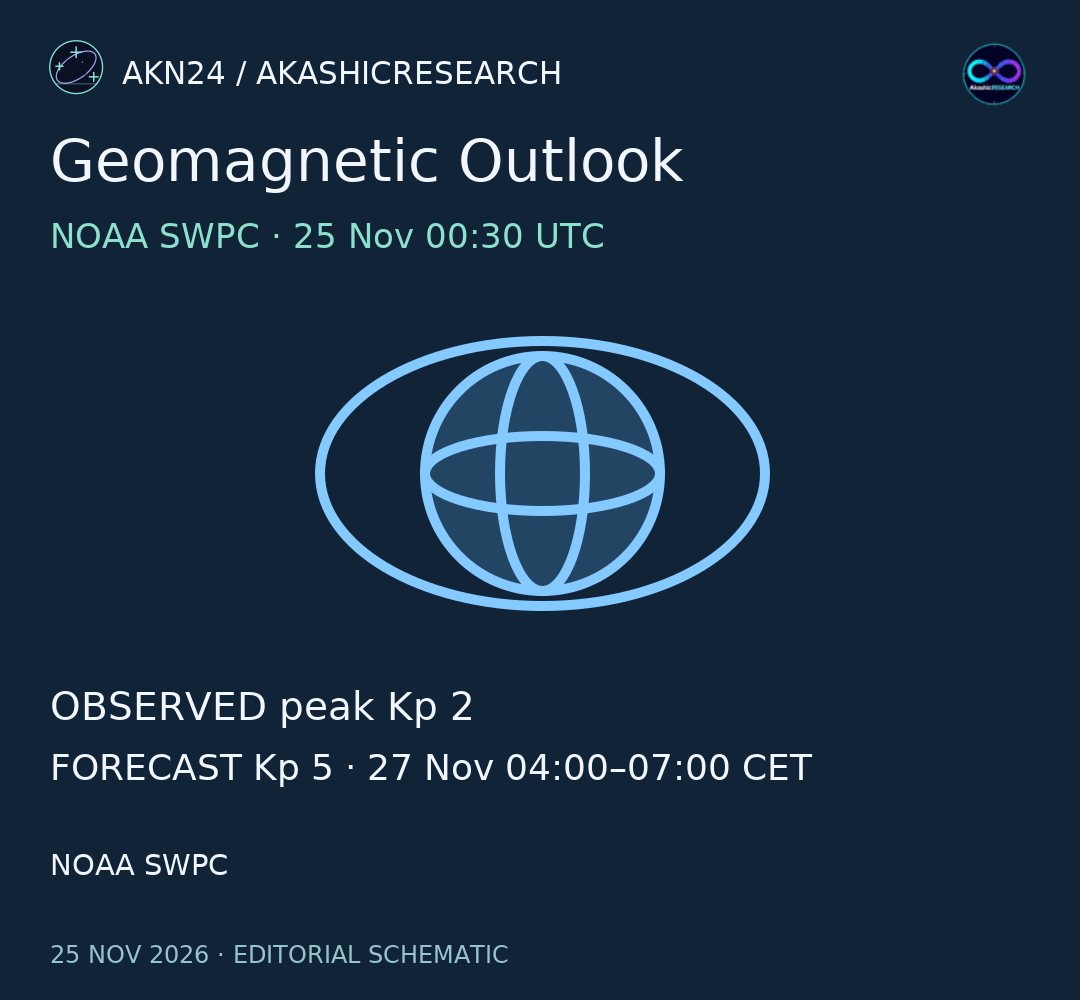
Observation: The preceding 24-hour peak three-hour Kp was 2. No radio blackouts were observed and solar radiation stayed below storm thresholds.
Interpretation: Measured geomagnetic conditions were below storm level.
Forecast: NOAA’s forecast peak is Kp 5 (G1) on 27 Nov, 03:00–06:00 UTC (04:00–07:00 CET). NOAA attributes the forecast to a high-speed solar-wind stream from a coronal hole.
Evidence limits and review scope
Testimony: No testimony.
Speculation: No claim about mood, sleep, consciousness or lunar causation.
Unresolved: Whether the forecast window verifies.
Full dated NOAA bulletin checked. The operational source URL rolls forward.